Can You Be Poetic and Funny
Examples of Personification in Poesy: Fun & Famous Poems
Personification attributes human-like qualities to things that are non-human (such every bit animals and pets) or inanimate (such as notebooks or stones). It uses subtle word choice to bring the desired tone to a poem — and in the case of humorous poems, the tone is funny! Explore several humorous examples of personification poems.
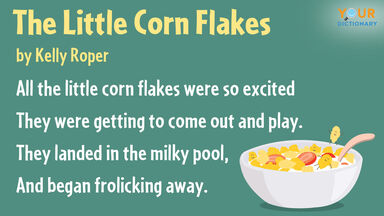 personification poem the picayune corn flakes
Funny Personification in Children's Verse
You'll find lots of examples of personification in poetry written for children. Young readers always giggle at the vision of a dancing tree and remember the author'south prose. Nursery rhymes and children's poems alike are filled with examples of personification.
Hey Diddle Diddle by Mother Goose
Personification in "Hey Diddle Diddle" by Mother Goose creates silly imagery, such as a dog laughing and a dish running abroad with a spoon. While this may be a unproblematic nursery rhyme, it'south a groovy example of personification'south ability to charm a smile out of united states of america and create a motion picture in our minds.
"Hey diddle, diddle,
The cat and the dabble,
The cow jumped over the moon;
The little dog laughed
To see such sport,
And the dish ran away with the spoon."
The Walrus and the Carpenter by Lewis Carroll
Lewis Carroll was another talented writer who used his literary devices well. In "The Walrus and the Carpenter," he personifies the sun and the moon in a style that could make the most hardened eye smile.
"The sun was shining on the sea,
Shining with all his might:
He did his very all-time to make
The billows polish and vivid —
And this was odd, because it was
The middle of the night."The moon was shining sulkily,
Because she thought the sun
Had got no business to be at that place
Afterwards the day was done —
'It'due south very rude of him,' she said,
'To come and spoil the fun.'"
Shoe Talk past Shel Silverstein
Shel Silverstein, the modernistic primary of personification, uses clever wordplay in his poem "Shoe Talk." He compares the shoe to a person, both physically and emotionally.
"There's no i to talk with-
I'll talk with my shoe.
He does have a natural language
And an inner soul, as well.
He's awfully well polished,
And then straightlaced and cracking
(But he talks nearly nada
But anxiety--feet--anxiety)."
The Chance of Timothy's Bike by Kelly Roper
For children, many of their favorite inanimate objects can take on very human qualities. Take this original poem example by Kelly Roper on the topic of a boy's bicycle.
Timothy'due south bike was a wonderful beast
Who liked to coil all day long.
Timothy clipped a card near the spokes
So they chattered out loud and strong.
One day Timothy was sick
And couldn't come up out to play.
The cycle was pitiful and a lilliputian chip mad,
So he decided to run abroad.
The bike pulled up his kickstand,
and quietly rolled beyond the lawn.
He hit the sidewalk and started to run,
And in a flash, he was gone.
He rode past the park, his favorite route,
Unaware he was watched by the throng.
The kids were astonished to see a bike
Rolling along with no passenger on.
The kids began to chase the bike,
And and so he sped quickly away.
He headed directly back to Timothy's house,
And put his kickstand down to stay.
The kids so knocked on Timothy'southward door,
To tell him how his wheel had run abroad.
Tim looked at the bike withal correct where he'd left it,
And closed the door saying "No way."
The Little Corn Flakes by Kelly Roper
Who said breakfast had to be wearisome? It is the most important meal of the 24-hour interval, after all. In this original poem, also past Kelly Roper, cereal comes to life, pond in a milky pool.
All the niggling corn flakes were so excited
They were getting to come out and play.
They landed in the milky pool,
And began frolicking away.
A spoon dipped in to give some a ride,
And returned many times for more.
The cornflakes' happiness didn't last long,
Because suddenly they were no more.
Adult Poetry With Humorous Personification
Adults should also exist able to let out a smile or ii at the prospect of personification. The same purpose prevails: it makes the poetry stand out in their minds and last forever. Even though in that location are seven common types of poetry, it'south non far-fetched to imagine personification popping into each category.
Dinnertime Chorus by Sharon Hendricks
Food plays such an integral part in our lives. We fifty-fifty plan our days around our meals. Given its place of prominence, information technology's difficult not to wax philosophical about food from time to time. Sharon Hendricks brings some of our favorite treats to life in "Dinnertime Chorus."
"The teapot sang as the h2o boiled
The ice cubes cackled in their glass
the teacups chattered to one another.
While the chairs were passing gas
The gravy gurgled merrily
As the oil danced in a pan."
If Dogs Could Talk by Denise Rodgers
Kids aren't the merely ones who can savor a humorous verse form about pets! In "If Dogs Could Talk," Denise Rodgers dreams about a world where dogs join our everyday conversations. Boy, the secrets they could tell!
"If dogs could talk, what they would say
would simply take your breath away.
Like: I don't want to see your knees.
Or: Pass a bit of roast beef, please.
When dawning lord's day shines in the east
they'd say: It's time for morning's feast.
When silent, still and somewhat broodish,
their minds are merely on your food dish."
Magdalen Walks past Oscar Wilde
Oscar Wilde's poem almost the beginning of leap, "Magdalen Walks," uses vivid imagery to paint a colorful picture of seasonal change. In the fourth stanza, he uses personification to make the forest even more lively.
"And the plane to the pine-tree is whispering some tale of love
Till it rustles with laughter and tosses its pall of dark-green,
And the gloom of the wych-elm'south hollow is lit with the iris sheen
Of the burnished rainbow throat and the silverish breast of a dove."
Those Naughty Keys by Kelly Roper
Kelly Roper'south original poem relays the common frustration of misplaced keys, describing the keys equally if they had a listen (and personality) of their own.
The keys hung patently on the claw,
Right where their owner left them.
But they were naughty keys so they
Jumped from the claw and left then.They loved to notice a hiding place
On the floor or betwixt cushions.
Merely today they sought to detect
a spot he'd never look in!They slipped inside a wastebasket
That sat just under their hook.
Those naughty keys just hid and grinned,
While their owner looked and looked.
The Perfume Bottles by Kelly Roper
In this example of personification in an original poem by Kelly Roper, the bottles of perfume on her dresser are vying for her attending.
Pretty little bottles of perfume
Stood at attention on the dresser.
"Which one of u.s. will she cull today?"
And they each took turns being the guesser."She'll choose me," the outset one said,
"Because I smell like roses."
"Not likely today," the 2nd bottle said.
"You'll stink upwards everyone's noses.""She'll cull me," the tertiary bottle said.
"She loves how I smell like sandalwood."
The second bottle replied again,
"She won't choose y'all. I know I never would."The woman came in, looked at her perfumes,
Sniffed bottle 2 and choosed her.
Bottle two cried, "Yes! She chose me, the all-time;
I guess you other two are the losers!"
Why Utilize Personification in Poetry?
Poems with personification use subtle word choices to create imagery and mood. Unlike anthropomorphism, personification does not involve animals or objects speaking and acting similar humans. It's used purely for descriptive purposes rather than to make the object or animal a character.
-
literal clarification - The old floorboards creaked nether my weight.
-
personification - The old floorboards groaned irritably under my weight.
-
anthropomorphism - The old floorboards yelled, "Go off of me!"
- literal description - The domestic dog walked to the doghouse.
- personification - The canis familiaris miserably trudged to the doghouse.
- anthropomorphism - "I can't believe she doesn't desire me inside," idea the dog, scowling on his way to the doghouse.
-
literal description - The teapot whistled loudly.
-
personification - The teapot screamed with indignation.
-
anthropomorphism - "Don't ignore me!" hollered the teapot, stomping its human foot.
Like many other poetic devices, personification can exist a subtle way to ready the desired mood. The closer you lot wait at various poems, the more you'll discover personification in verse.
Personification in Poetry: Pretty Perfect
Personification is a member of the literary device family tree, only it's also a citizen of the land of figurative language. Figurative language compares 2 things in an unusual and interesting style. It lends itself beautifully to poetry considering it paints such a brilliant mental pic. While yous're creating fanciful visions in your mind, enjoy these examples of imagery poems. Younger readers can also relish these examples of personification for kids.
huffakerlethe1985.blogspot.com
Source: https://examples.yourdictionary.com/humorous-examples-of-personification-in-poetry.html
0 Response to "Can You Be Poetic and Funny"
Post a Comment